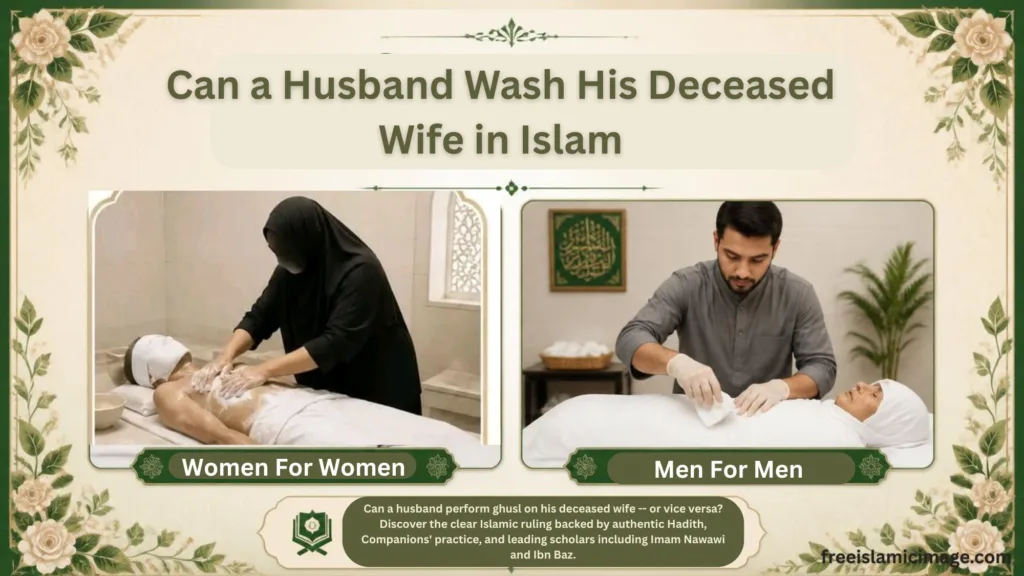
The Islamic Ruling on Ghusl Between Husband and Wife After Death
Answer:
Yes. It is permissible in Islam for a husband to wash (perform ghusl on) his deceased wife, and for a wife to wash her deceased husband. This ruling is established by an authentic hadith of the Prophet Muhammad ﷺ, the practice of the Companions of the Prophet, and the consensus of the majority of Islamic scholars. The common belief that death completely ends all marital permissibility — including ghusl — has no basis in authentic Islamic sources.
When a loved one passes away, the grieving family faces an immediate set of responsibilities — among them, the sacred obligation of ghusl: the ritual washing of the deceased before burial. This is a fard kifayah (communal obligation) in Islam, meaning that if some members of the community fulfill it, the obligation is lifted from others.
But a question arises that many Muslims are unsure about — sometimes deeply so:
Can a husband wash his deceased wife? Can a wife wash her deceased husband?
Many people believe the answer is no — that death immediately terminates the marital bond entirely, removing all rights and permissibilities between husband and wife, including the right to perform ghusl.
This belief, while widespread, has no foundation in the Quran or authentic Sunnah. In fact, the authentic Islamic evidence points clearly in the opposite direction. This article presents that evidence completely, so that Muslims can follow the correct ruling with confidence and act with wisdom during one of the most difficult moments of their lives.
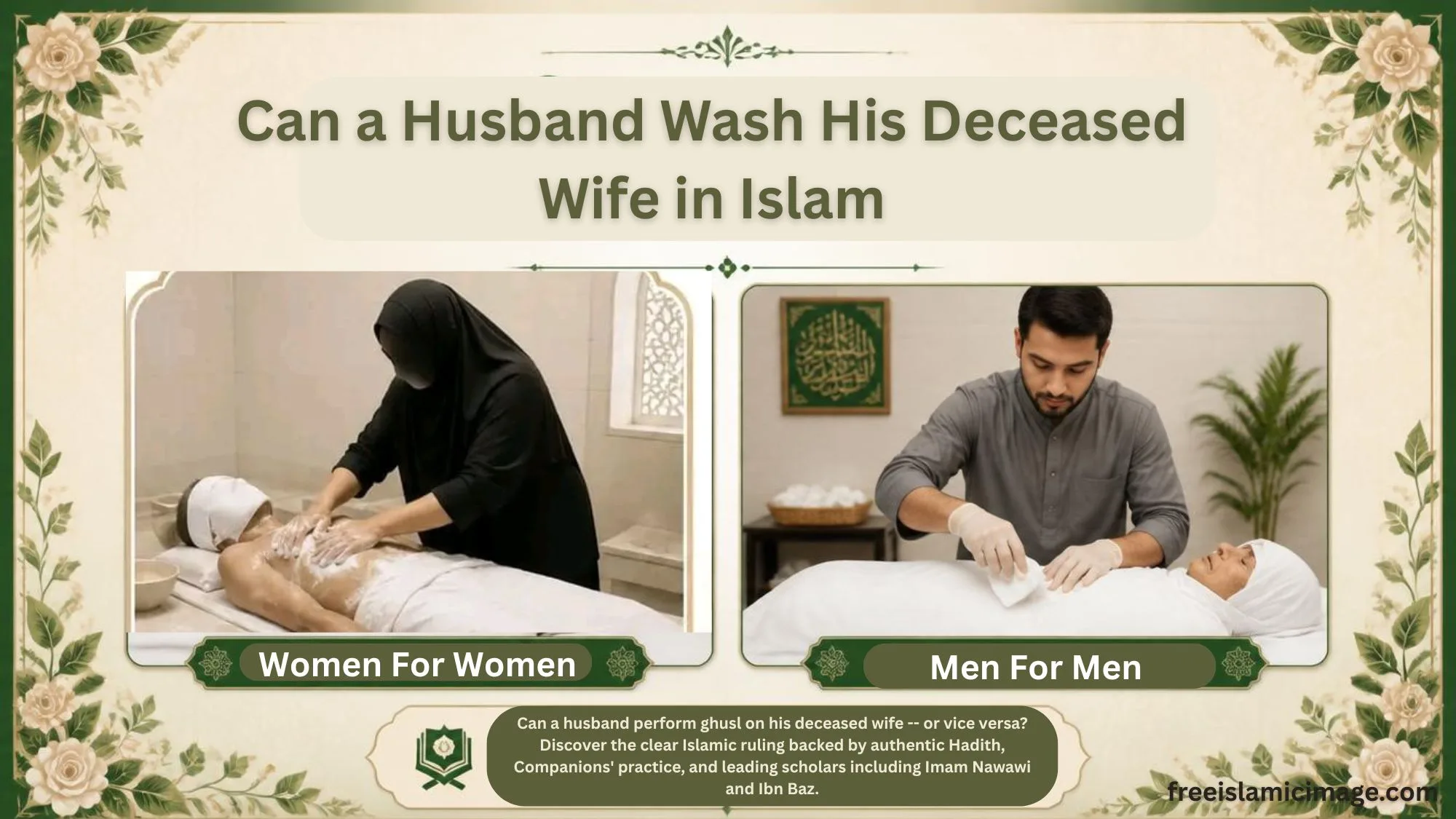
The Clear Quranic Principle: Follow the Messenger
While the Quran does not directly address the specific question of ghusl between spouses, it establishes the principle that governs all such questions:
“Whatever the Messenger gives you, take it. And whatever he forbids you, refrain from it.”
— Surah Al-Hashr 59:7
This verse establishes that the Sunnah — the practice and sayings of the Prophet Muhammad ﷺ — is the definitive authority on matters that the Quran addresses in general terms. On the question of spouses performing ghusl for each other, the Sunnah is clear and explicit.
The Prophet’s ﷺ Own Words: The Most Direct Evidence
The most powerful evidence on this question comes directly from the Prophet Muhammad ﷺ. In an authentic hadith, he addressed his beloved wife Aisha (may Allah be pleased with her) and told her:
“If you died before me, I would wash you, shroud you, pray over you, and bury you.”
— Prophet Muhammad ﷺ — Musnad Ahmad (25950), Sunan Ibn Majah (1465), Mishkat al-Masabih (5971)
This hadith is explicit and direct. The Prophet of Allah — who would never say something permissible when it was forbidden, and who was the most careful of all people in matters of halal and haram — told his wife that he would personally wash her body if she died before him.
There is no ambiguity here. The Prophet described washing his deceased wife as something he would do, without any qualification, condition, or indication of prohibition. This hadith alone is sufficient evidence that a husband may perform ghusl on his deceased wife.
Aisha’s Own Testimony: The Wife’s Right to Wash Her Husband
The evidence for the reverse — a wife washing her deceased husband — is equally strong. It comes from Aisha herself, in a statement that reveals both the permissibility of this act and a personal reflection she had after the Prophet’s death:
“If I had understood at the beginning what I came to understand later, none would have washed the Prophet except his wives.”
— Aisha (may Allah be pleased with her) — Sunan Abu Dawud (3141), authenticated as Sahih by Imam al-Albani
This statement from Aisha is remarkable. She is expressing that had she known the ruling clearly from the start, she would have ensured that the Prophet’s wives — his spouses — performed his ghusl. This clearly implies that the Prophet’s wives had the right to do so, and that Aisha considered this the preferable course of action.
Imam al-Albani, one of the foremost hadith scholars of the modern era, authenticated this narration as sahih in his work Ahkam al-Janaiz.
The Practice of the Companions: Living Proof
Beyond the words of the Prophet and Aisha, the actual practice of the Companions of the Prophet provides the most concrete evidence. Two famous examples stand out:
Ali Performed Ghusl for Fatimah
When Fatimah (may Allah be pleased with her) — the beloved daughter of the Prophet Muhammad ﷺ — passed away, it was her husband Ali ibn Abi Talib (may Allah be pleased with him) who performed her ghusl.
This is recorded in Sunan al-Daraqutni (1833) with a hasan chain and is cited by Imam al-Albani in Salat al-Rasul (pp. 120-121).
Ali was among the most knowledgeable of the Companions in matters of fiqh. His action of washing Fatimah — the Prophet’s own daughter — without any recorded objection from any Companion carries enormous weight as Islamic evidence.
Abu Bakr Was Washed by His Wife
When the first Caliph of Islam, Abu Bakr al-Siddiq (may Allah be pleased with him), was on his deathbed, he specifically requested in his will (wasiyyah) that his wife Asma bint Umays (may Allah be pleased with her) perform his ghusl.
This is recorded in al-Sunan al-Kubra by Imam al-Bayhaqi, Vol. 3, p. 397.
Abu Bakr was the closest Companion of the Prophet, the man who knew Islam most deeply after the Prophet himself. He would never have made this request if he believed it was prohibited. His wasiyyah is itself an act of religious guidance — a Companion’s confirmed practice (amal) that carries legal weight in Islamic jurisprudence.
What the Scholars Say: Scholarly Consensus
The evidence from the Sunnah and the Companions is reflected in the opinions of the greatest scholars in Islamic history:
Imam al-Nawawi (may Allah have mercy on him):
“A husband may wash his deceased wife and a wife may wash her deceased husband. The majority of scholars are in agreement on this.”
— al-Majmu Sharh al-Muhadhdhab, Vol. 5, pp. 114 and 122
Sheikh Abd al-Aziz ibn Baz (may Allah have mercy on him):
“A husband may wash his deceased wife and a wife may wash her deceased husband. There is no prohibition in Islamic law for this.”
— Majmu Fatawa wa Maqalat, Ibn Baz, Vol. 13, p. 109
Imam al-Nawawi is one of the greatest fiqh scholars in Islamic history and the author of the most comprehensive work in Shafi’i fiqh. Sheikh Ibn Baz was the Grand Mufti of Saudi Arabia and among the most authoritative Islamic scholars of the modern era. Their agreement on this ruling, combined with the evidence from the Sunnah and Companions, establishes the ruling beyond reasonable doubt.
Addressing the Common Misconception
The most common objection raised against this ruling is this: “Death ends the marital bond entirely. Therefore, a husband and wife become strangers (ajnabi) to each other after death, and the permissibilities of marriage no longer apply.”
This objection sounds logical, but it fails when tested against the Islamic evidence. Here is why:
- No sahih evidence supports it. There is no authentic Quranic verse and no authentic hadith that states death makes spouses strangers to each other for the purposes of ghusl.
- The Prophetic evidence contradicts it. The Prophet ﷺ explicitly said he would wash Aisha if she died before him (Ibn Majah 1465). If death had made her a stranger to him, he could not have said this.
- The Companions contradicted it in practice. Ali washed Fatimah. Abu Bakr requested his wife wash him. None of the other Companions objected to these actions — and the silence of the Companions in the face of a known practice is considered tacit approval (taqrir) in Islamic jurisprudence.
- The distinction is important. Death does end certain marital rights — such as physical intimacy, inheritance in some cases, and the obligation of nafaqah. But ending these rights does not mean ending all marital permissibilities. Ghusl is a separate ruling established by separate evidence.
In other words, the fact that death changes the marital relationship in some ways does not mean it changes it in all ways. The Sunnah establishes that ghusl between spouses is specifically permitted — and no authentic evidence removes that permission.
Practical Guidance for Muslims
For Muslims facing this situation, here is a clear practical summary:
- A husband may wash his deceased wife. This is established by the Prophet’s hadith (Musnad Ahmad 25950, Ibn Majah 1465) and the practice of Ali washing Fatimah.
- A wife may wash her deceased husband. This is established by Aisha’s statement (Abu Dawud 3141) and the practice of Abu Bakr’s wife washing him per his dying wish (Bayhaqi 3/397).
- This is not obligatory — it is permissible. The community may arrange for other women to wash a deceased woman, or other men to wash a deceased man. The spouse performing the ghusl is a valid and honored option, not a requirement.
- Following the sunnah in this is an act of love. For a spouse who wishes to perform this final act of service for their partner, doing so follows the example of the Prophet and his most honored Companions.
- Do not accept rulings without evidence. Any claim that this is prohibited must be supported by authentic Islamic evidence. In the absence of such evidence, the established ruling from authentic sources applies.
A Final Word: Knowledge Is the Antidote to Misconception
Islam is a religion of evidence. No ruling is valid unless it is grounded in the Quran, the authentic Sunnah, or the consensus of scholars derived from these sources. The prohibition of spouses performing ghusl for each other has none of these foundations.
What does have these foundations — the Prophet’s own words, Aisha’s testimony, Ali’s action, Abu Bakr’s dying request, and the documented consensus of the majority of scholars — is the permissibility of this act.
For a spouse who has lost their partner, the ability to perform this final, tender act of care — to fulfill for their beloved what the Prophet himself said he would have done for Aisha — is not a violation of Islamic law. It is an act that Islam has sanctioned, that the Companions practiced, and that the greatest scholars of Islam have confirmed.
May Allah grant every Muslim knowledge that protects them from misconception, and may He grant us all the ability to fulfill the rights of those we love — in life and in death. Ameen.
Frequently Asked Questions
Q: Can a husband wash (perform ghusl on) his deceased wife in Islam?
Yes. This is established by the Prophet’s explicit statement to Aisha: “If you died before me, I would wash you.” (Musnad Ahmad 25950, Ibn Majah 1465). Imam al-Nawawi confirmed the majority scholarly consensus permitting this (al-Majmu 5/114), and Sheikh Ibn Baz affirmed there is no prohibition in Islamic law (Majmu Fatawa 13/109).
Q: Can a wife wash her deceased husband in Islam?
Yes. Aisha stated that she wished the Prophet’s wives had washed him (Abu Dawud 3141, authenticated by al-Albani). Abu Bakr made a dying request for his wife Asma bint Umays to wash him (Bayhaqi 3/397). Both the statement and the Companions’ practice establish this permissibility clearly.
Q: Does death completely end the permissibilities of marriage in Islam?
Death ends certain marital rights such as physical intimacy and some inheritance obligations. However, it does not remove all marital permissibilities. The authentic Islamic evidence specifically establishes that ghusl between spouses remains permitted after death, based on the Prophet’s hadith and the Companions’ practice.
Q: Who washed Fatimah bint Muhammad after her death?
Fatimah (may Allah be pleased with her), the daughter of the Prophet Muhammad ﷺ, was washed by her husband Ali ibn Abi Talib after her death. This is recorded in Sunan al-Daraqutni (1833) with a hasan chain and is cited by Imam al-Albani in Salat al-Rasul (pp. 120-121).
Q: Is there any hadith prohibiting a husband from washing his deceased wife?
No. There is no authentic hadith or Quranic verse that prohibits a husband from washing his deceased wife or a wife from washing her deceased husband. All authentic evidence on this matter confirms permissibility, not prohibition.
View Muslim Fashion T-Shirt Design Here: SHOP NOW