Ashura and Muharram: What Happened on the 9th & 10th of Muharram? A Complete Islamic Guide
The Significance of 9th & 10th Ashura and Muharram Complete Guide
Muharram is the first month of the Islamic (Hijri) year and is called “the Month of Allah” due to its special status. The 9th and 10th of Muharram, especially the day of Ashura, hold deep historical, spiritual, and religious importance for Muslims worldwide.
What Happened on the 9th and 10th of Muharram?
9th Muharram
The Prophet Muhammad (ﷺ) intended to fast on the 9th along with the 10th to distinguish Muslims from the Jews, who only fasted the 10th.
This day is a Sunnah fasting day recommended as part of the Ashura fast.
10th Muharram — Ashura
The 10th of Muharram is one of the most historically significant days in Islam. Several major events occurred:
Key Events on Ashura
Allah saved Prophet Musa (AS) and the Israelites from Pharaoh.
Prophet Nuh’s (AS) Ark rested on Mount Judi after the flood.
Many scholars mention Allah forgave Adam (AS) on this day.
In Islamic history, the most painful event:
The martyrdom of Imam Hussain (RA), the grandson of the Prophet (ﷺ), at Karbala in 61 AH (680 CE).
Why Are the 9th and 10th of Ashura and Muharram Important for Fasting?
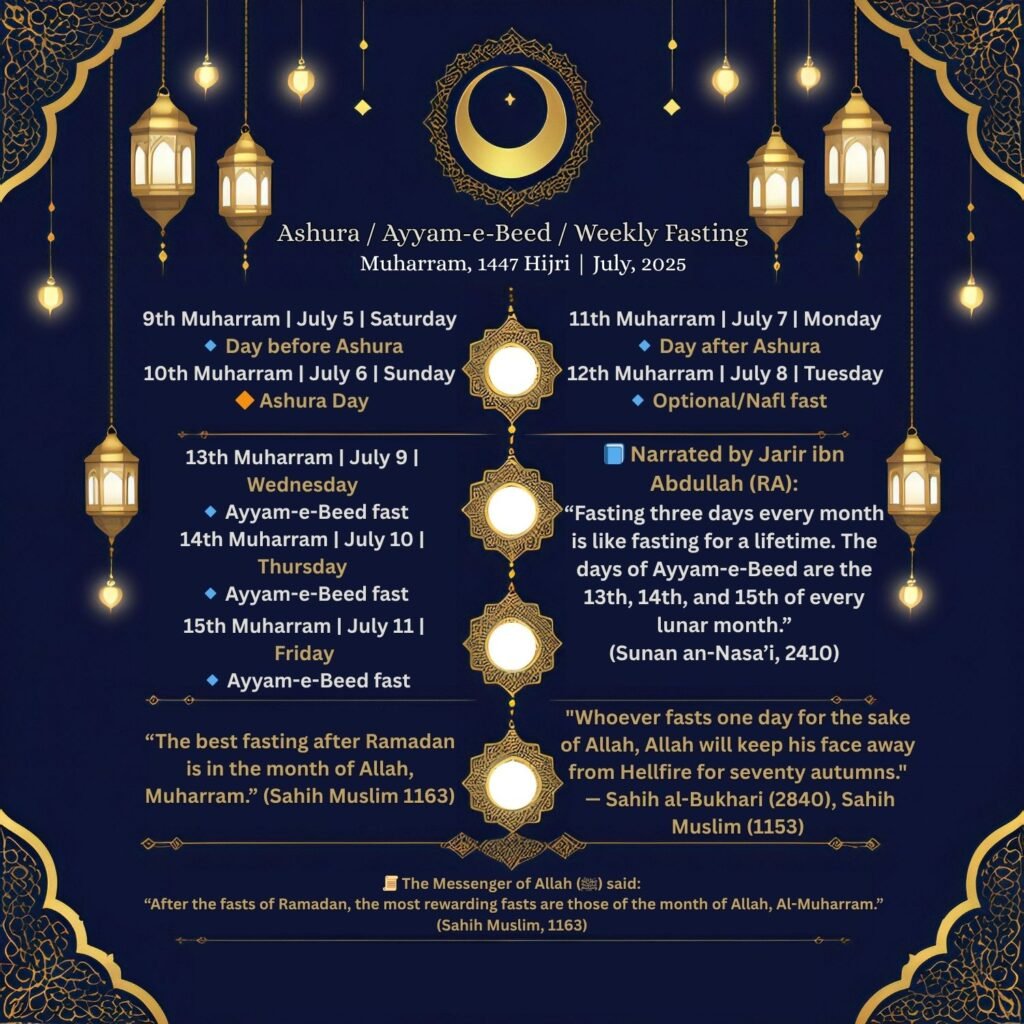
The Prophet ﷺ said the best fast after Ramadan is in Muharram (Muslim 1163).
Fasting Ashura expiates one year of minor sins (Muslim 1162).
Fasting 9th + 10th or 10th + 11th is the Sunnah.
Was Jesus (Isa AS) Born on Ashura?
No.
There is no authentic evidence that Isa (AS) was born on the 10th of Muharram. This belief exists in some cultures but is not supported by authentic Islamic narrations.
Who Was Killed on 10 Muharram?
Imam Hussain ibn Ali (RA), the beloved grandson of Prophet Muhammad ﷺ, was martyred at Karbala on the 10th of Muharram.
This is the reason many Muslims feel deep sorrow during this month.
What Should Muslims Do in Ashura and Muharram?
- Fast on the 9th & 10th or 10th & 11th.
- Fast 13th–15th (Ayyam-ul-Beed) for extra reward.
- Increase dhikr, du’a, charity, and good deeds.
- Start the Islamic new year with repentance and positive habits.
What Not To Do in Ashura and Muharram
- Islam does not permit:
- Self-harm, beating oneself, or rituals involving injury.
- Crying loudly, wailing, or extreme mourning.
- Celebrating with innovations (bid’ah).
- Believing in superstitions tied to the month.
Why Do Some Muslims Cry During Muharram?
Because of the tragic martyrdom of Imam Hussain (RA).
Islam allows feeling sad, remembering his sacrifice, and honoring his courage—
but not self-harm or extreme rituals.
- Major Practices in Muharram
- Sunnah fasting
- Dhikr & du’a
- Charity
- Islamic reflection
- Teaching the story of Musa (AS) and the lessons from Karbala

What Should We Do on 9 and 10 Muharram?
- Fast both days.
- Make abundant du’a, especially.
- for forgiveness
- for protection
- for relief from hardship
- Give charity (many scholars recommend charity on Ashura).
- Read about the stories of Musa (AS) and Imam Hussain (RA).
Buy & Support US: Ummah Apparel

Is It Haram to Say “OMG”?
Not necessarily.
If you mean “Oh My God” respectfully, it is not haram.
But it should not be used casually in disrespectful situations.
What Is Muharram Celebrated For?
- It marks the start of the Islamic year.
- It commemorates:
- the rescue of Musa (AS)
- the trials of many Prophets
- the courage of Imam Hussain (RA)
- Muslims “observe” Muharram, not celebrate it like an Eid.
Is Muharram a Holiday on 7 July (2025)?
- July 6, 2025 is expected to be the 10th of Muharram (Ashura).
- Many countries will have a public holiday on July 6, not July 7.
- 7 July 2025 (Monday) is 11th Muharram and is not a public holiday in most countries.
- Always check your country’s official holiday announcement.
- Why Is July 7 Important in 2025?
- It is the 11th of Muharram, the day after Ashura—
- a recommended day for fasting, but not a holiday.
Summary: The Real Story of Muharram
- Muharram is one of the holiest Islamic months.
- The 10th (Ashura) marks great events.
- Allah saving Musa (AS), Nuh’s Ark, and other major divine mercies.
- It also marks the tragic martyrdom of Imam Hussain (RA).
- Muslims fast, pray, do dhikr, and increase good deeds.
- Islam forbids harmful rituals and innovations.
- The 9th and 10th fasting carries immense reward.