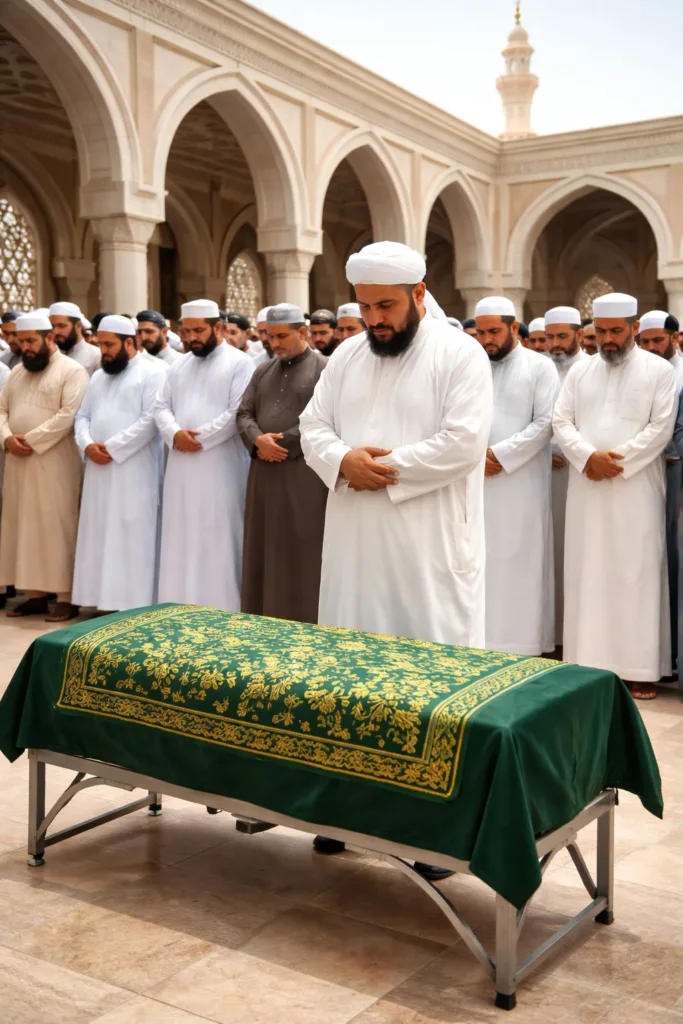
What do you wear to a Janazah prayer?
Muslims should wear modest, clean, and simple clothing to a Janazah prayer.
- Men: Loose clothes covering from navel to knees (preferably full Islamic dress like a thobe or kurta)
- Women: Loose clothing covering the entire body, including hijab
- Avoid flashy, tight, or colorful outfits
- White or neutral colors are preferred, but not required
What should Muslims wear to a Janazah prayer?
The key principle is modesty (haya) in Islam. Clothing should:
- Fully cover the body
- Not attract attention
- Be clean and respectful
How long do Muslims mourn a death?
- General mourning: 3 days
- For a widow: 4 months and 10 days (iddah period)
Excessive mourning beyond this is discouraged.
Can I pray Janazah with shoes on?
Yes, you can pray Janazah with shoes on if:
- The shoes are clean
- There is no impurity (najis)
However, many people remove shoes out of respect.
What 3 colors not to wear to a funeral?
Islam does not strictly forbid colors, but it’s best to avoid:
- Bright red
- Neon or flashy colors
- Glittery or attention-seeking outfits
Stick to simple and calm tones.
How long does a Janazah prayer take?
The Janazah prayer is very short:
- Usually 5–10 minutes
How to pray Janazah prayer step by step?
Step-by-step:
- Make intention (niyyah)
- First Takbir (Allahu Akbar) → Recite Surah Al-Fatiha
- Second Takbir → Send blessings upon Prophet ﷺ (Durood)
- Third Takbir → Make dua for the deceased
- Fourth Takbir → Short pause, then end with salam
How to perform the Janazah prayer?
It is a Fard Kifayah (communal obligation). No ruku or sujood—only standing.
What are the three forbidden times to pray in Islam?
There are 3 times when prayer is prohibited:
- At sunrise
- At midday (when sun is at its peak)
- At sunset
How many rakat for Janazah prayer?
Janazah prayer has:
- No rakat
- It consists of 4 takbirs only
Can Muslims cry at funerals?
Yes, crying is allowed in Islam.
However:
- Loud wailing or screaming is not allowed
- Showing patience is encouraged
What dua is used in the Janazah prayer?
One common dua:
“Allahumma ighfir lahu warhamhu wa ‘afihi wa’fu ‘anhu…”
Meaning:
“O Allah, forgive him, have mercy on him, grant him ease and pardon him…”
What dua is said during Janazah prayer?
For adults, children, and different cases, duas vary. The general dua asks for:
- Forgiveness
- Mercy
- Jannah (Paradise)
Can Muslims be cremated?
No. Cremation is strictly forbidden in Islam.
- The body must be:
- Washed (ghusl)
- Shrouded (kafan)
- Buried
What dua is used in front of dead body?
When seeing a deceased person, you can say:
“Inna lillahi wa inna ilayhi raji’un”
Meaning:
“Indeed, we belong to Allah, and to Him we return.”
What dua is used for those who died in Islam?
“Allahumma ighfir li hayyina wa mayyitina…”
Meaning:
“O Allah, forgive our living and our dead…”
How do you write “Allahumma” correctly?
Correct spelling:
Allahumma (اللَّهُمَّ)
It means:
“O Allah…”
Final Note
Janazah prayer is a powerful reminder of the Hereafter. It is simple, quick, and deeply meaningful—focused on dua, mercy, and humility before Allah.
Can Women Attend Janazah Prayer?
According to Islamic Sharī‘ah, performing the funeral prayer (Ṣalāt al-Janāzah) is farḍ kifāyah (a collective obligation). Farḍ kifāyah means that if two or three people perform it, the obligation is fulfilled on behalf of the entire community; but if no one performs it, then everyone in the locality becomes sinful.
The funeral prayer is obligatory only for men. There is no ruling that obligates women to participate in it. Therefore, it is not permissible for women to leave their homes with the intention of attending a funeral prayer, because there are clear prohibitions regarding this from the Messenger of Allah ﷺ and from the Companions and the Tābi‘īn.
Ḥaḍrat Umm ‘Aṭiyyah (raḍiyallāhu ‘anhā) narrates:
وَنَهَانَا أَن نَخْرُجَ فِي جَنَازَةٍ
“The Messenger of Allah ﷺ forbade us from going out for a funeral.”
(Al-Mu‘jam al-Kabīr by Ṭabarānī, 25/45)
The Tābi‘ī, Yār ibn ‘Abdullāh (raḥimahullāh), said:
“The Messenger of Allah ﷺ was following a funeral. He suddenly saw an elderly woman following it as well. Upon seeing this, the Messenger of Allah ﷺ became angry, and the signs of anger were visible on his face. He ordered that the woman be sent back, and she was returned. Then the bier was placed down, but he did not begin the funeral prayer. When the people said, ‘By the One Who sent you with the truth, that woman has gone behind the houses of Madinah,’ only then did he pronounce the takbīr for the funeral prayer.”
(Muṣannaf ‘Abdur Razzaq, Ḥadīth 6290)
Ḥaḍrat ‘Amr ibn Qays (raḥimahullāh) said:
“We were present at a funeral in which Abū Umāmah was also present. When he saw some women at the funeral, he drove them away.”
(Muṣannaf Ibn Abī Shaybah, 11408)
Muḥammad ibn al-Muntashir (raḥimahullāh) said:
“Masrūq (raḥimahullāh) would not perform a funeral prayer in which a woman was present.”
(Muṣannaf Ibn Abī Shaybah, 11403)
The renowned jurist Imām Sha‘bī (raḥimahullāh) was asked whether women should perform funeral prayers. He replied:
“Women should not perform the funeral prayer, whether they are in a state of purity or menstruation.”
(Muṣannaf ‘Abdur Razzaq, 6297)
Secondly, the Sharī‘ah guidance regarding women is that—from acts of worship to all aspects of life—their activities should be distinct from men, and their presence and movement should remain concealed from men’s gaze. While it is a strong command for men to perform the five daily prayers in congregation at the mosque, women have been encouraged to perform prayer inside their homes.
Even in Masjid an-Nabawi, where one prayer equals the reward of one thousand prayers, and despite the blessing of praying behind the Messenger of Allah ﷺ himself, the female Companions were still instructed that praying in the most secluded place of their homes was better for them. There is no authentic ḥadīth addressing women that commands or encourages them to attend congregational prayers in the mosque.
Umm Ḥumayd (raḍiyallāhu ‘anhā) said:
She came to the Messenger of Allah ﷺ and said, “O Messenger of Allah, I love to pray behind you.” He replied, “I know that you love to pray behind me, but know that your prayer in the inner part of your home is better than your prayer in the outer room; your prayer in the outer room is better than your prayer in the courtyard; your prayer in the courtyard is better than your prayer in the mosque of your locality; and your prayer in your local mosque is better than your prayer in my mosque.”
The narrator says that upon this, Umm Ḥumayd instructed that a prayer space be built for her in the most secluded and concealed part of her home, and she continued to pray there until her death.
(Musnad Aḥmad, 27090)
Ḥaḍrat ‘Abdullāh ibn Mas‘ūd (raḍiyallāhu ‘anhu) narrates:
“Women are a form of ‘awrah (that which must be concealed). When a woman leaves her home without necessity, Shayṭān pursues her and says, ‘You will not pass by anyone except that you will attract him.’ When a woman dresses and is asked where she is going, she says, ‘I am going to visit a sick person,’ or ‘to attend a funeral,’ or ‘to pray in the mosque.’ Yet no act of worship for a woman is better than worshipping her Lord inside her own home.”
(Al-Mu‘jam al-Kabīr by Ṭabarānī, 8914; Majma‘ al-Zawā’id, 2118)
From the above-mentioned aḥādīth and the practices of the Companions and Tābi‘īn, it is clearly established that it is not permissible for women to go out for the purpose of attending a funeral prayer. Women should remain at home and supplicate for the deceased, seeking reward and forgiveness for them. This is the instruction of Islam.
However, if a deceased person passes away in an area where no men are available to perform the funeral prayer, and a few women perform it, then the obligation of farḍ kifāyah will be fulfilled.
Additionally, if women are already present in the Ḥaram for ṭawāf or for performing Ḥajj or ‘Umrah, and a funeral prayer is established at that time, then such women may join the congregation while observing proper purdah and remaining in designated areas. This is because funeral prayer itself is not intrinsically forbidden for women; rather, due to concerns of modesty and fitnah, the Messenger of Allah ﷺ and the Companions and Tābi‘īn forbade women from leaving their homes to attend funerals.
References:
Fatāwā Shāmī 1/566, Fatāwā ‘Ālamgīrī 4/450 & 1/162, Ḥalbat al-Mujallī 2/607, Sharḥ al-Munyah p. 594, Durr al-Mukhtār 2/232, Binnūrī Fatāwā 143906200027
Khairul Islam
20/10/2023
Hanafi Fiqh
View Muslim Fashion T-Shirt Design Here: SHOP NOW

Can Women Attend Janazah Prayer?
janazah,
women in islam, islamic law, hanafi islam, funeral prayer