Does Your Husband Love You Less After Marriage? Islam Answers
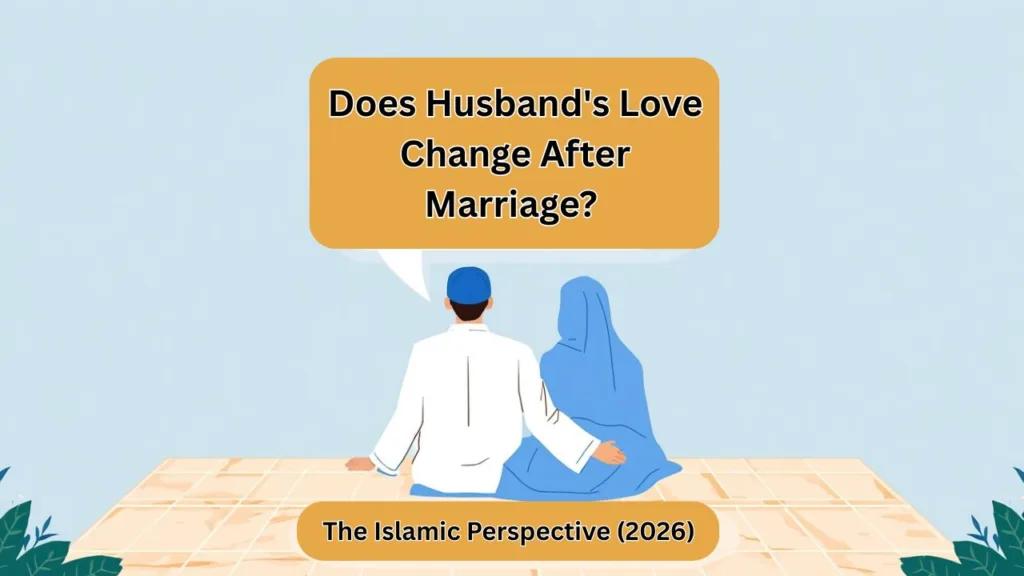
Does a Husband’s Love Change After Marriage? What Islam Teaches Us
Featured Snippet Answer: A husband’s love does not disappear after marriage — it transforms. Early marital love is driven by emotion and novelty, while mature love in Islam is expressed through responsibility, protection, mercy (rahma), and tranquility (sukoon). The Quran (30:21) describes this transformation as one of Allah’s greatest signs.
If you are a married woman who has ever quietly wondered, “Why doesn’t my husband act the same way he did before our wedding?” — you are not alone. This question lives in the hearts of countless wives, whispered in loneliness but rarely spoken aloud.
The man who once called you three times a day now barely texts back in an hour. The one who used to plan surprises is now buried in spreadsheets. Has something broken? Has love faded? Or has something deeper, quieter, and more permanent taken root?
This article explores the Islamic framework for understanding love in marriage — why it changes, what it becomes, and why that change is actually a sign of a thriving relationship, not a failing one.
The Science and Sunnah of Early Love
Modern psychology calls the early stage of any romantic relationship the “limerence” phase — a neurological state where the brain floods with dopamine and norepinephrine. Everything your partner does feels electric. Every message, every glance, every small gesture feels monumental.
This phase is beautiful — and it is also temporary. Research consistently shows that this intense emotional high lasts between 12 to 24 months. After that, the nervous system recalibrates. This is not failure. This is biology.
Islam has always understood this. The Quran does not describe marriage primarily as a romance — it describes it as a source of sukoon: tranquility, peace, and rest.
“And of His signs is that He created for you from yourselves mates that you may find tranquility in them; and He placed between you affection (mawadda) and mercy (rahma).” — Surah Ar-Rum 30:21
Notice the order: first sukoon (tranquility), then mawadda (deep affection), then rahma (mercy and compassion). Allah does not describe marriage as a place of constant excitement — He describes it as a place of rest. That distinction matters enormously.
View Muslim Fashion T-Shirt Design Here: SHOP NOW



Why Your Husband Seems Different — The Real Reasons
When a man steps into the role of a husband, particularly within an Islamic household, he assumes a weight that few outsiders fully appreciate. Understanding the source of his behavioral changes is the beginning of genuine compassion.
1. The Burden of Qiwamah (Financial Guardianship)
Islam places the responsibility of financial provision squarely on the husband’s shoulders. Allah says in Surah An-Nisa (4:34) that men are the qawwamun — the caretakers and protectors — of their families. This is not a privilege; it is a daily responsibility that does not clock out.
When your husband comes home quiet and distracted, he may be carrying mortgage anxiety, career pressure, or concern about providing adequately. His silence is not indifference — it may be the sound of someone carrying a heavy load.
2. Love Languages Shift Over Time
Gary Chapman’s well-known concept of “love languages” aligns surprisingly well with Islamic teachings on marital duty. Early in a relationship, men tend to express love through words and time — gifts, dates, long conversations. As the relationship matures, many men shift toward expressing love through acts of service and provision.
He wakes up at Fajr and goes to work so you and your children are cared for. He fixes the broken tap without being asked. He quietly handles the car insurance renewal. In his mind, every single one of these acts is an expression of love — just not one that comes wrapped in words.
3. Comfort and Familiarity Replace Performance
Before marriage, both partners are, to some degree, performing. We dress up, we hold back annoyances, we put our best face forward. After marriage, authentic comfort sets in — and this is actually a sign of trust and safety, not complacency.
“The best of you are those who are best to their wives, and I am the best among you to my wives.” — Prophet Muhammad ﷺ — Sunan al-Tirmidhi (3895)
Signs That His Love Has Matured (Not Vanished)
Mature love does not announce itself the way new love does. Here is what it looks like in a marriage:
- Consistent presence: He shows up when it matters most.
- Quiet concern: He worries about your health, safety, and happiness even when you don’t ask him to.
- Consistent provision: He works tirelessly to ensure your needs are met — financially, emotionally, spiritually.
- Loyalty under pressure: He doesn’t abandon the relationship when things get hard.
- Remembering details: He makes small, thoughtful gestures that show he pays attention to what you need.
- Protecting your honor: He treats you with dignity in front of others.
None of these are Instagram-worthy moments. But each one, rooted in Islamic values of amanah (trustworthiness) and taqwa (God-consciousness), represents a love that has earned its permanence.
The Wife’s Role: Recognizing and Reciprocating
Islam does not place the responsibility of marital harmony entirely on one partner. Just as the Quran reminds wives of their husbands’ unseen sacrifices, it also calls on both partners to be each other’s garments — libas — covering one another’s shortcomings with grace.
“They (your wives) are a garment for you and you are a garment for them.” — Surah Al-Baqarah 2:187
A garment does not demand to be noticed — it protects, warms, and covers. This mutual covering is the heart of a mature Islamic marriage.
If you feel disconnected from your husband, consider these steps rooted in Islamic relationship guidance:
- Open a conversation gently: Choose a calm moment and express how you feel using ‘I’ statements, not accusations.
- Ask about his world: Ask what is weighing on him — and listen without immediately offering solutions.
- Express gratitude specifically: Acknowledge his hard work and sacrifice out loud. Men, like women, need to hear that they are valued.
- Pray together: Make du’a together, even briefly. Shared spiritual practice creates profound intimacy.
- Create space for closeness: Physical closeness — a hand on the shoulder, sitting together without phones — matters more than we admit.
When to Seek Further Help
It is important to distinguish between love that has matured and love that has genuinely deteriorated. Not every change in a husband’s behavior is healthy transformation — some changes signal deeper problems that deserve attention.
If your husband is consistently dismissive, emotionally abusive, neglecting his Islamic obligations toward you, or you feel genuinely unsafe, please do not normalize this under the umbrella of “mature love.” Speak to a trusted Islamic scholar, a qualified Muslim counselor, or a family elder you trust.
Islam does not call women to endure harm in silence. The Messenger of Allah ﷺ said: “There shall be no harm and no reciprocation of harm.” (Ibn Majah, 2341) Your well-being is not secondary to marital preservation.
A Final Word: Love That Stays Is Love That Grows
The love that survives ten years of marriage — through financial stress, health challenges, raising children, and navigating in-laws — is not the same love that walked down the aisle. It is stronger. It is quieter. And it is, by any honest measure, more beautiful.
The Quran does not describe marriage as a fairy tale. It describes it as a sign (ayah) of Allah’s power and wisdom. The fact that two imperfect human beings choose to remain by each other’s side, to protect and show mercy to one another day after day, is itself an act of worship.
So the next time you catch your husband hunched over bills at midnight, or watch him rise early to provide for your family without complaint — perhaps that is the most sincere love letter he has ever written you. He just wrote it in actions, not words.
FAQ
Q: Is it normal for a husband to be less romantic after marriage? Yes, it is completely normal. Early romantic intensity is driven by neurological responses that naturally settle over time. In Islam, marital love is meant to evolve into sukoon (tranquility), mawadda (deep affection), and rahma (mercy) — a deeper and more lasting bond than initial excitement.
Q: What does Islam say about love fading in marriage? Islam does not view the fading of early romantic excitement as love disappearing. The Quran (30:21) describes marital love in terms of tranquility, affection, and mercy — qualities that deepen over time rather than diminish. If anything, mature Islamic love is considered more spiritually significant.
Q: How can I reconnect with my husband when I feel emotionally distant? Islam encourages open, gentle communication between spouses. Express your feelings calmly, express gratitude for his efforts, pray together, and create moments of physical and emotional closeness. If distance persists, seeking guidance from a qualified Islamic marriage counselor is recommended.
Q: Does a husband’s love really show through provision and responsibility? According to Islamic teachings and the concept of qiwamah (guardianship), a husband’s primary expression of love often manifests through his tireless effort to provide, protect, and care for his family. This ‘acts of service’ form of love is deeply valued in Islam, even when it is less verbally expressive.
Q: Can marriage get better after the honeymoon phase? Absolutely. Many Islamic scholars and marital therapists agree that marriages that survive the transition from excitement to committed partnership grow significantly deeper and more fulfilling. The Prophet ﷺ himself described the best of men as those who are best to their wives — a standard that applies through every phase of marriage.
Read More:
- How to Perform Wudu Step by Step : https://freeislamicimage.com/how-to-perform-wudu-step-by-step/
Magic Cannot Harm Without Allah’s Permission : https://freeislamicimage.com/magic/
- Global Azan Time : https://freeislamicimage.com/global-azan-time/