Islamic Daily Routine Around the Five Prayers: A Practical Schedule for a Blessed, Productive Day
Featured Snippet Answer:
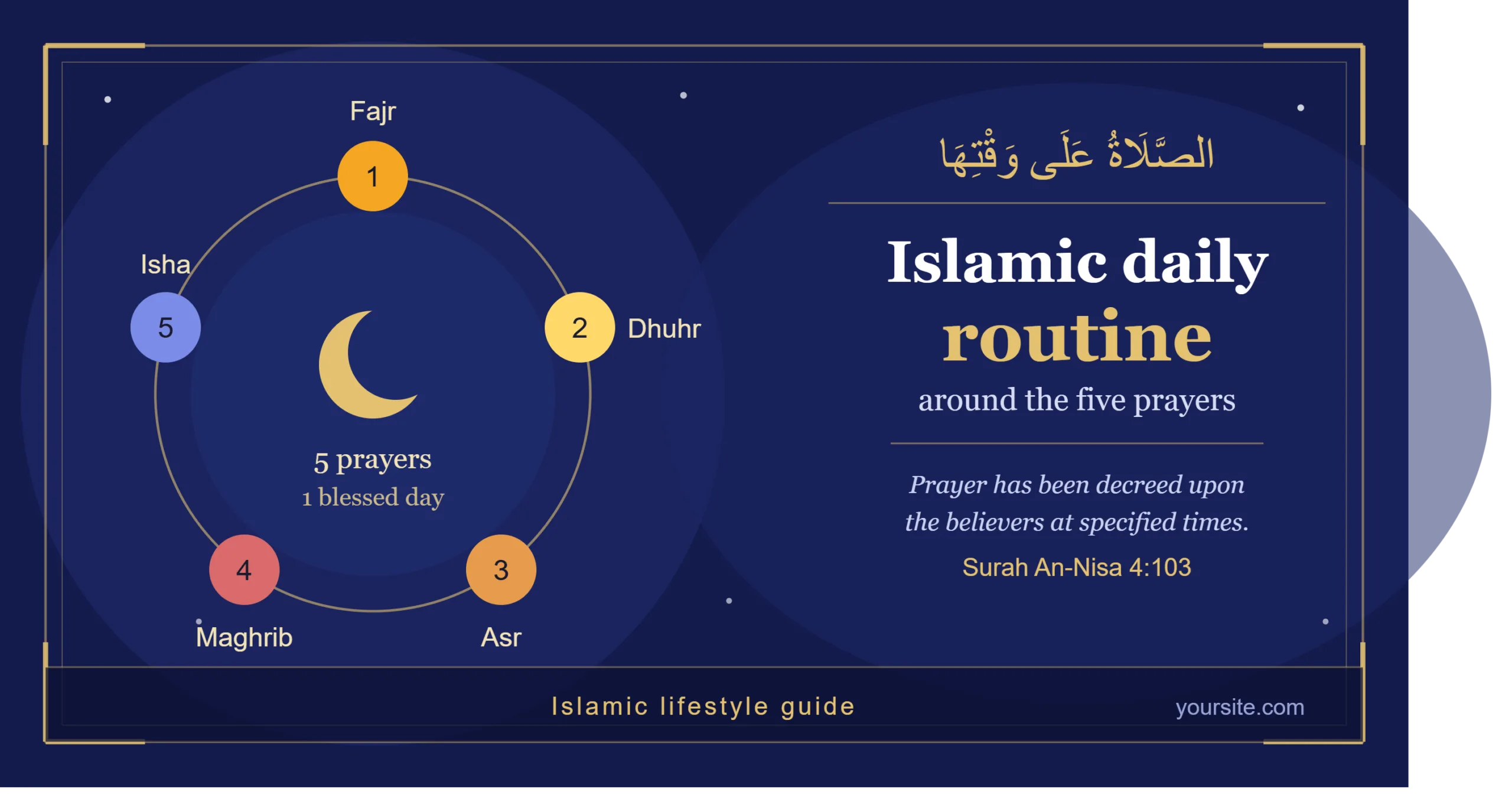
An Islamic daily routine is built by treating each of the five prayers as a checkpoint. Use the time after Fajr for Quran, morning adhkar, and your most demanding work. Use Dhuhr as a midday reset with a short rest (qaylulah). Use Asr to finish tasks and exercise, Maghrib for family, and Isha for reflection, planning, and early sleep. Prayer at its proper time is among the most beloved deeds to Allah (Sahih al-Bukhari 527).
Most of us fit prayer into our day. We squeeze Fajr in before the rush, rush through Dhuhr between meetings, and pray Isha when we finally sit down. The day is the main thing, and salah is something we manage around it.
What if we flipped it? What if the five prayers were the skeleton of the day, and everything else (work, study, family, rest, exercise) was arranged around them?
This is not a new idea. It is how Muslims lived for centuries, and it still works today. This guide walks through a practical Islamic daily routine around the five prayers, with the Quran and authentic Hadith behind each habit, so you can build a day that is both productive and blessed.
Why Build Your Day Around Salah?
Allah has made prayer a structure of time, not just a ritual:
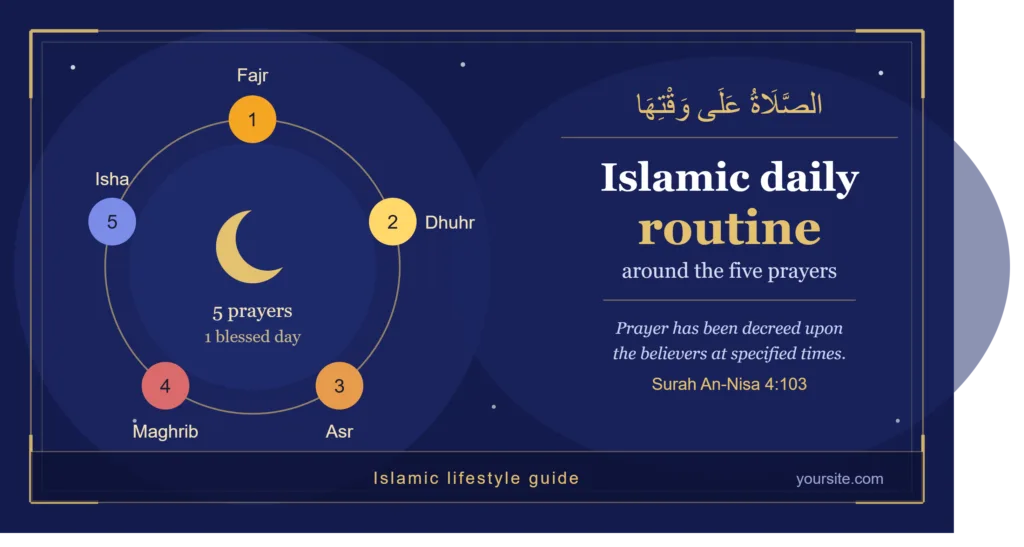
“Indeed, prayer has been decreed upon the believers at specified times.”
— Surah An-Nisa 4:103
Five fixed times spread across the day means five natural pauses. Each one interrupts the autopilot, reminds you why you are working, and resets your attention. Productivity experts today recommend regular breaks. Islam built them into worship fourteen centuries ago.
The Prophet ﷺ was asked which deed is most beloved to Allah. He answered:
“Prayer at its proper time.”
— Prophet Muhammad ﷺ — Sahih al-Bukhari (527), Sahih Muslim (85)
He also warned about one of the quiet ways we waste our lives:
“There are two blessings that many people lose out on: health and free time.”
— Prophet Muhammad ﷺ — Sahih al-Bukhari (6412)
A routine organized around salah is simply a way of not losing out on your time.
1. Fajr: The Most Valuable Part of Your Day
The hours after Fajr are the gold of your day. The Prophet ﷺ made a specific dua for the early part of the day:
“O Allah, bless my ummah in their early mornings.”
— Prophet Muhammad ﷺ — Sunan Abu Dawud (2606), Jami al-Tirmidhi (1212), hasan
That is why going straight back under the blanket after praying is a quiet loss. You are sleeping through the part of the day the Prophet asked Allah to bless.
What to do after Fajr
- Remain in remembrance. Sit for a few minutes in dhikr and recite the morning adhkar. The Prophet ﷺ said that whoever prays Fajr in congregation, sits remembering Allah until sunrise, then prays two rakats receives a reward like a complete Hajj and Umrah (Jami al-Tirmidhi 586, hasan).
- Read a little Quran with meaning. Even a page with its translation is enough. The goal is steady contact, not volume.
- Keep your phone away. This is the biggest rule. Your mind is freshest right now. Do not hand it to a screen.
- Do your hardest work first. Study, writing, learning a skill, or whatever will actually change your life. Your focus is at its best.
- Add light movement. A short walk or gentle exercise wakes the body without draining you.
Win the two hours after Fajr and the rest of the day tends to follow.
2. Dhuhr: A Midday Reset Button
By noon, most people have been working for hours. Focus fades, energy dips, and the day starts to blur. Dhuhr arrives exactly when you need it.
Do not treat Dhuhr as a break from work. See it as a reset button.
- Aim to finish your main morning tasks before Dhuhr. This gives the prayer a clear role as a checkpoint.
- Pray, then eat a moderate lunch. Eating until you are heavy makes the afternoon sluggish.
- Take a short rest. This is qaylulah, a brief midday rest. The Companions used to take it after Jumu’ah (Sahih al-Bukhari 939). Keep it short so you wake up refreshed rather than groggy.
- Review your plan. After waking, check how much of the morning plan you completed and set up your second focus session.
Many people waste the hours after Dhuhr. A reset here puts you ahead of most people at the same hour.
3. Asr: The Last Productive Window
Many people think the day is basically over by Asr. In reality this is where a lot is won or lost. Asr is also one of the two prayers the Prophet ﷺ singled out for protection:
“Whoever misses the Asr prayer, it is as if he has lost his family and his wealth.”
— Prophet Muhammad ﷺ — Sahih al-Bukhari (552), Sahih Muslim (626)
The Quran itself opens a whole surah by taking an oath on time, understood by many scholars as al-Asr, the age or the late afternoon:
“By time. Indeed, mankind is in loss.”
— Surah Al-Asr 103:1-2
Scholars differ on whether al-Asr here means time in general or the late afternoon specifically, but the message is clear either way: how you spend your time determines whether you gain or lose. Scrolling away the Asr hours is a costly habit.
How to use Asr
- Pray Asr on time. Do not let it drift toward sunset.
- Finish the small tasks. Replies, calls, accounts, errands, the work that needs little deep thinking.
- Give your body time. Exercise, sport, or a walk outdoors fits well in this window.
- Do the evening adhkar. Make time for the evening remembrance before Maghrib.
4. Maghrib: Close the Workday and Come Home
Maghrib is the door closing on the working day. After praying, step away from the outside world and give your time to the people at home.
We spend all day running for people outside, while those closest to us get the least. The Prophet ﷺ set a different example. Aisha (may Allah be pleased with her) was asked what he did at home and said:
“He used to be busy serving his family, and when the prayer was called he would go out for prayer.”
— Aisha (may Allah be pleased with her) — Sahih al-Bukhari (676)
Sit with your parents. Talk with your spouse and children. Share tea. These are not interruptions to your life. They are your life.
- Read a little Quran or a beneficial book. The mind is calm and receptive in the evening.
- Do a light revision. Look back at what you learned in the morning to lock it in.
- Try to eat dinner between Maghrib and Isha. Eating late pushes sleep late, and late sleep puts Fajr at risk.
5. Isha: Win Tomorrow Tonight
Isha is the last checkpoint of the day. After praying, sit for five minutes and take stock:
- What went well today? Thank Allah for it.
- Where did I waste time? Be honest, without beating yourself up.
- What did I do wrong that needs tawbah? Turn to Allah with a sincere repentance.
- What are tomorrow’s three main tasks? Write them down so you do not have to think about them in the morning.
Then put the phone away. This is both the hardest and the most important step.
The Prophet ﷺ disliked sleeping before Isha and idle conversation after it (Sahih al-Bukhari 568). Scholars explain that beneficial talk, such as learning, family matters, or helping others, is fine. The concern is wasteful talk that steals your sleep.
Before sleeping, he taught a simple routine:
“When you go to your bed, perform wudu as you would for prayer, then lie on your right side, and recite the sleep supplication.”
— Prophet Muhammad ﷺ — Sahih al-Bukhari (247), Sahih Muslim (2710)
Remember: your Fajr really starts the night before, at Isha.
A Sample Day at a Glance
Use this as a template and adapt it to your own work and family schedule. The times follow the prayers, not the clock, so it works in every season and city.
- Fajr: Blessing and deep focus. Dhikr, Quran with meaning, no phone, hardest task, light exercise.
- Dhuhr: Reset. Finish morning tasks, moderate lunch, short rest, review your plan.
- Asr: Finish strong. Small tasks, exercise, evening adhkar.
- Maghrib: Family and learning. Time with parents and spouse, Quran or reading, early dinner.
- Isha: Reflection and rest. Self-review, tawbah, plan tomorrow, phone away, wudu, early sleep.
Common Obstacles and How to Fix Them
- I cannot wake up for Fajr. Fix your night first. Sleep earlier, keep the phone out of reach, make wudu before bed, and make a sincere intention to wake up.
- My work schedule is unpredictable. Anchor the routine to what you can control: Fajr, one midday reset, and the Isha review. Even partial structure helps.
- I fall asleep after Fajr. Do something active straight away: refresh your wudu, take a short walk, or stand while reading Quran.
- I feel guilty when I miss a day. Start again at the next prayer. Every salah is a new beginning.
Final Word: Let Salah Set the Rhythm of Your Day
A day organized around the five prayers is not a restriction. It is a rhythm. Five times, you pause, return to your Lord, and then go back to your work with a clearer heart.
You do not have to change everything at once. Begin with one habit: win the first two hours after Fajr, or protect your Isha review. Add the next habit when the first feels natural.
May Allah make us among those who preserve their prayers, make our time a source of blessing, and grant us the success of the best of days. Ameen.
Frequently Asked Questions
Q: How can I structure my day around the five prayers?
Treat each prayer as a checkpoint: Fajr for Quran and focused work, Dhuhr for a midday reset, Asr to finish tasks and exercise, Maghrib for family time, and Isha for reflection and early sleep. Allah has prescribed prayer at fixed times (Surah An-Nisa 4:103), which gives your day a natural rhythm.
Q: What is the best thing to do after Fajr?
Stay in remembrance of Allah, read some Quran, recite the morning adhkar, and use your fresh mind for your hardest work. The Prophet ﷺ said whoever prays Fajr in congregation, remembers Allah until sunrise, then prays two rakats receives a reward like Hajj and Umrah (Tirmidhi 586, hasan).
Q: Is taking a nap after Dhuhr sunnah?
Qaylulah, a short midday rest, was practiced by the Companions (Sahih al-Bukhari 939) and is encouraged by scholars. Keep it brief so that you wake refreshed rather than groggy.
Q: Why is Asr prayer emphasized so much?
The Prophet ﷺ said that whoever misses Asr is as if he lost his family and wealth (Sahih al-Bukhari 552). Asr is also named alongside Fajr in the hadith about the promise of Paradise (Bukhari 574), and the Quran swears by time itself in Surah Al-Asr.
Q: How do I stop wasting time after Isha?
Put your phone away, review your day for five minutes, plan three tasks for tomorrow, make wudu, recite the sleep adhkar, and sleep early. The Prophet ﷺ disliked idle talk after Isha (Sahih al-Bukhari 568).
View Muslim Fashion T-Shirt Design Here: SHOP NOW