how to perform wudu?/ How do you do wudu step by step?
Step-by-step Wudu (Ablution):
- Make intention (niyyah) in your heart.
- Say Bismillah.
- Wash hands up to wrists three times.
- Rinse mouth three times.
- Rinse nose three times.
- Wash face three times.
- Wash arms up to elbows three times (right first).
- Wipe head once (masah).
- Wipe inside & outside of ears once.
- Wash feet up to ankles three times (right first).
View T-Shirt Designs Here: https://bestdesign-74.creator-spring.com/listing/wudu




What is the order of wudu?
- Hands
- Mouth
- Nose
- Face
- Arms
- Head
- Ears
- Feet
This is based on Qur’an 5:6 and Sunnah.
How long should wudu take?
There is no fixed time. Usually 2–5 minutes is enough.
It should be done calmly without wasting water.
Does wudu break if you kiss? / Can kissing break wudu? / Does kissing break your wudu? / Does kissing break wudu reddit? / Is kissing break wudu?
Kissing does NOT break wudu unless it leads to:
discharge, or
sexual arousal that causes madhiy (pre-ejaculate).
If nothing comes out, wudu remains valid.
What counts as breaking wudu?
Wudu breaks if:
Anything exits the private parts (urine, stool, gas, madhiy, maniy, blood).
Deep sleep where awareness is lost.
Loss of consciousness.
Touching private parts with the hand directly (according to many scholars).
Kissing, hugging, touching spouse does NOT break wudu unless discharge occurs.
Will kissing break your fast?
Kissing does not break the fast, but:
It is discouraged if it may lead to sexual arousal or intercourse.
Can I kiss my wife private parts in Islam?
Yes, most scholars permit it as long as:
No harmful swallowing occurs.
It does not lead to prohibited acts.
However, during fasting hours of Ramadan, it is not allowed because it may lead to intercourse or invalidation of fast.
Does a hug break wudu?
No, hugging does not break wudu unless discharge comes out.
What is wudu for Muslims?
Wudu is ritual purification with water before prayer and some other acts of worship.
It cleanses the body spiritually and physically.
Do Muslims do wudu every day?
Yes, Muslims perform wudu:
before every obligatory prayer (if wudu is broken)
or whenever needed for purity
Some do it multiple times a day.
What do Muslims do in wudu?
They wash and wipe specific parts of the body to purify before worship.
What are the four rules of wudu? / What are the 4 acts of wudu?
The 4 Fard (obligatory) acts:
Washing face
Washing arms up to elbows
Wiping part of the head
Washing feet up to ankles
What are the 7 steps of wudu? (Common simple version)
- Niyyah
- Hands
- Mouth
- Nose
- Face
- Arms
- Wipe head & ears and wash feet
(Some lists combine steps differently, but essentials remain the same.)
What are the steps of wudu in order?
Same as the 10-step version given above.
What are the 7 obligatory steps of ablution?
Strictly speaking, Islamically only four are obligatory.
Anything listed as seven includes Sunnah acts, not obligations.
How many steps are there in a wudhu?
Scholars commonly list 7–10 steps, depending on details.
What do I say when doing wudu?
Start with Bismillah.
After completing wudu, recite:
Ashhadu alla ilaha illallah wahdahu la sharika lah, wa ashhadu anna Muhammadan ‘abduhu wa rasuluh.
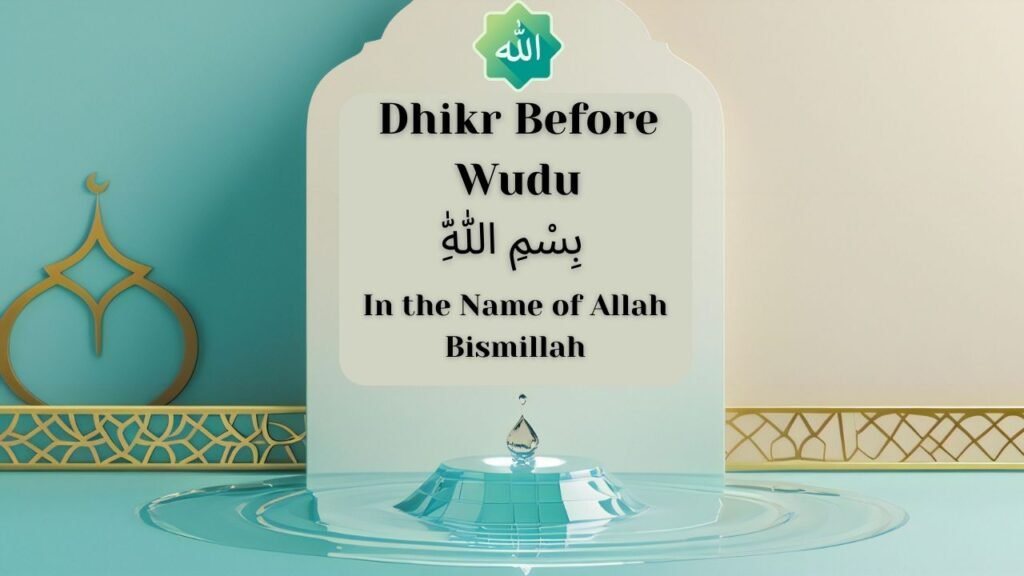
Dhikr Before Wudu
بِسْمِ اللّٰهِ
In the Name of Allah
Bismillah
It is Sunnah to say “Bismillah” or “Bismillahir Rahmanir Rahim” before performing wudu.
A hadith states: “The wudu of the one who does not mention the name of Allah at its beginning is not valid.” [1]
Abu Dawood, No. 101; Ibn Majah, No. 397; Ahmad, No. 9418. Also see: Irwa’ul Ghalil 1/122
[1] This hadith has been narrated with several weak chains; through the combination of different weak chains it has been considered acceptable. Tirmidhi (Chapters on Taharah, 20 – Chapter on Mentioning the Name…), 1/37–39 (Indian ed. 1/13); Zayla’i, Nasbur Rayah 1/3–6; Ibn Hajar, Talkhisul Habir 1/72; Al-Albani, Sahihul Jami’ 2/1256, No. 7570; Rahe Bilayat – Dhikr No. 36
Dhikr After Wudu #1
اَشْهَدُ اَنْ لَّآ اِلٰهَ اِلَّا اللّٰهُ وَحْدَهٗ لَا شَرِيْكَ لَهٗ وَاَشْهَدُ اَنَّ مُحَمَّدًا عَبْدُهٗ وَرَسُوْلُهٗ
I bear witness that there is no true deity except Allah alone, without any partner, and I bear witness that Muhammad is His servant and Messenger.
Ash-hadu an laa ilaaha illallaahu wahdahu laa shareeka lahu wa ash-hadu anna Muhammadan ‘abduhu wa rasooluhu
‘Umar (RA) said: The Messenger of Allah (ﷺ) said, “If anyone performs wudu properly and completely, then recites this dhikr, all eight gates of Paradise will be opened for him, and he may enter through whichever of them he wishes.”
Muslim 1/209, No. 234
Narrated by Jābir bin ‘Abdullāh (RA):
He said: I heard the Messenger of Allah (ﷺ) say:
“The best dhikr is Lā ilāha illallāh (There is no deity except Allah), and the best du‘ā’ is Alhamdulillāh (All praise is for Allah).” [3132]
Footnote: [3132] At-Tirmidhī 3383, 1497; Mishkāt 2306; At-Ta‘līqur-Rāghib 2/229.
Sunan Ibn Mājah, Hadith no. 3800
Hadith Status: Hasan (Good)
Source: Al-Hadith App
Narrated by Anas (RA):
The Messenger of Allah (ﷺ) said:
“Indeed, these mosques are not appropriate places for urine and filth. They are only for the remembrance of Allah and the recitation of the Qur’an.” Or the Messenger of Allah (ﷺ) said something similar.
Footnote: (Ṣaḥīḥ al-Bukhārī 219, 221, 6025; Muslim 284, 285; At-Tirmidhī 147; An-Nasā’ī 53, 55, 329; Ibn Mājah 528; Ahmad 11672, 11722, 12298, 12572, 12955; Muwaṭṭa’ Mālik 144; Ad-Dārimī 740)
Riyāḍus Ṣāliḥīn, Hadith no. 1704
Hadith Status: Ṣaḥīḥ (Authentic)
Narrated by Abū Sa‘īd (RA):
He said, the Messenger of Allah (ﷺ) said:
“Allah, the Blessed and Exalted, says: Whoever is occupied by the Qur’an from My remembrance and from asking Me, I will grant him more than what I give to those who ask. And the superiority of the Speech of Allah over all other speech is like the superiority of Allah over His creation.”
(Narrated by At-Tirmidhī, Ad-Dārimī, and Al-Bayhaqī in Shu‘ab al-Īmān. Imām At-Tirmidhī said: This is a ḥadīth ḥasan gharīb.) [1]
Footnote: [1] Ḍa‘īf: At-Tirmidhī 2926, Ḍa‘īfah 1335, Ḍa‘īf at-Targhīb 860, Ḍa‘īf al-Jāmi‘ 6435, Ad-Dārimī 3399, Shu‘ab al-Īmān 1860. Because in its chain of narration is ‘Aṭiyyah al-‘Awfī who is a weak narrator, and Muḥammad ibn Ḥasan ibn Abī Yazīd who is accused of lying. Ibn Ma‘īn (RA) considered him unreliable.
Mishkāt al-Maṣābīḥ, Hadith no. 2136
Hadith Status: Ḍa‘īf (Weak)
Source: Al-Hadith App
Read more: freeislamicimage.com
Collected.