Virtue of Dhikr
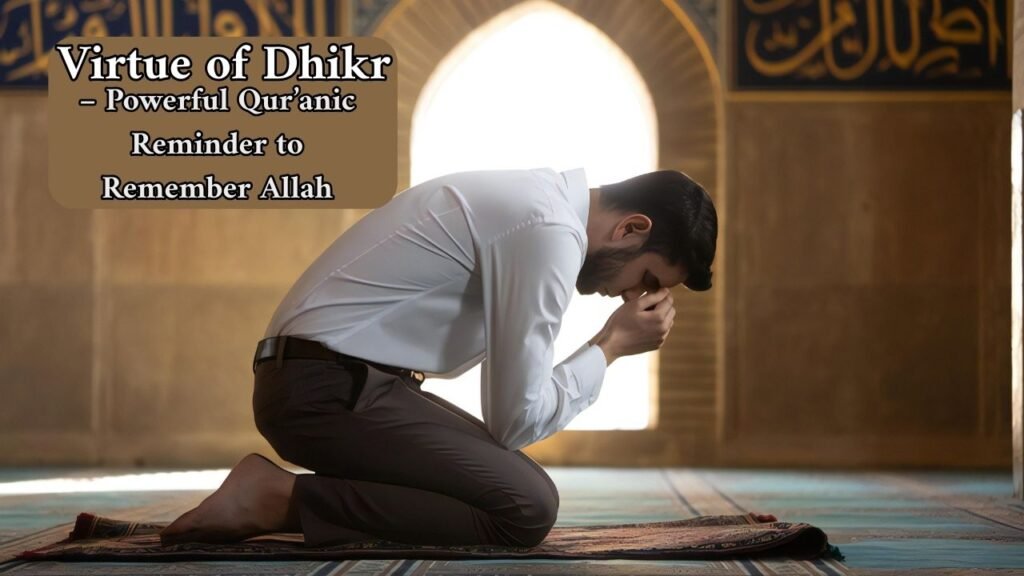
Virtue of Dhikr the remembrance of Allah — is one of the greatest acts of worship in Islam. Allah Himself commands believers to remember Him often, promising forgiveness, reward, and His divine closeness. The Qur’an highlights that those who engage in frequent remembrance are honored by Allah, while the Prophet ﷺ describes Dhikr as the best of deeds, the purifier of the heart, and the difference between the living and the dead. Through Dhikr, a believer finds peace, spiritual strength, and a constant connection to their Creator in every moment of life.
View My T-Shirt Designs Here: Ummah Apparel

Reminder Answers (Short & Simple)
What is the dhikr 33 times?
After every fard prayer, Muslims say:
- SubhanAllah 33 times,
- Alhamdulillah 33 times,
- Allahu Akbar 34 times.
Why do we say dhikr 33 times?
The Prophet ﷺ taught this dhikr as a powerful way to gain reward, strengthen the heart, and stay connected to Allah after every prayer.
What is the dua 33 times?
The post-prayer tasbeeh: SubhanAllah, Alhamdulillah, Allahu Akbar—each repeated as instructed.
What dua is read 33 times?
SubhanAllah and Alhamdulillah are each read 33 times, followed by Allahu Akbar 34 times.
What is 33 33 34 in Islam?
This refers to the post-salah dhikr:
- SubhanAllah (33)
- Alhamdulillah (33)
- Allahu Akbar (34)
Which dhikr 1000 times?
Many scholars recommend saying La ilaha illa Allah or SubhanAllah frequently—even 1000 times—for great reward.
Will Allah forgive me if I say Astaghfirullah 100 times?
Yes. The Prophet ﷺ said he sought forgiveness more than 70–100 times daily. Sincere Astaghfirullah brings Allah’s forgiveness and mercy.
How to do dhikr properly?
Do it with:
- A clean heart
- Focus
- Understanding
- Consistency
- Humility
You may recite silently or softly.
How to perform dhikr properly?
Sit calmly, face Qiblah if possible, remember Allah with presence, count dhikr with fingers or mentally, and reflect on the meaning.
How do I get my dua 100% accepted?
- Ask with sincere heart
- Avoid haram
- Make dua with certainty
- Be patient
- Call upon Allah during accepted times (Tahajjud, after salah, last third of the night)
- Increase istighfar and good deeds
How much dhikr should I do a day?
As much as your heart can handle. The best dhikr is continuous, even if small. The Prophet ﷺ encouraged remembering Allah “much.”
What do you recite in dhikr?
Common forms include:
- SubhanAllah
- Alhamdulillah
- Allahu Akbar
- La ilaha illa Allah
- Astaghfirullah
- La hawla wa la quwwata illa billah
What dhikr to say 100 times?
The Prophet ﷺ recommended:
- SubhanAllah wa bihamdih (100 times)
- Astaghfirullah (100 times)
How to do dhikr properly? (Reminder)
Do it mindfully, consistently, and with the intention of pleasing Allah alone.
Virtue of Dhikr
Allah the Almighty says:
فَاذْكُرُوْنِيْٓ اَذْكُرْكُمْ وَاشْكُرُوْا لِيْ وَلَا تَكْفُرُوْنِ
“So remember Me; I will remember you. And be grateful to Me and do not be ungrateful to Me.”
Surah Al-Baqarah – 2:152
يٰٓاَيُّهَا الَّذِيْنَ اٰمَنُوا اذْكُرُوا اللّٰهَ ذِكْرًا كَثِيْرًا
“O you who have believed! Remember Allah with much remembrance.”
Surah Al-Ahzab – 33:41
وَالذّٰكِرِيْنَ اللّٰهَ كَثِيْرًا وَّالذّٰكِرٰتِ اَعَدَّ اللّٰهُ لَهُمْ مَّغْفِرَةً وَّاَجْرًا عَظِيْمًا
“And the men who remember Allah much and the women who remember Allah much – Allah has prepared for them forgiveness and a great reward.”
Surah Al-Ahzab – 33:35
وَاذْكُرْ رَّبَّكَ فِيْ نَفْسِكَ تَضَرُّعًا وَّخِيْفَةً وَّدُوْنَ الْجَهْرِ مِنَ الْقَوْلِ بِالْغُدُوِّ وَالْاٰصَالِ وَلَا تَكُنْ مِّنَ الْغٰفِلِيْنَ
“And remember your Lord within yourself in humility and fear and without loudness in words, in the mornings and evenings; and do not be among the heedless.”
Surah Al-A‘raf – 7:205
The Prophet (peace and blessings be upon him) also said, “The example of the one who remembers his Lord and the one who does not remember his Lord is like that of the living and the dead.” [1]
The Messenger of Allah (peace and blessings be upon him) also said, “Shall I not inform you of the best of deeds, the purest of them with your Master, the one that raises you most in rank, better for you than spending gold and silver (in the way of Allah), and better for you than meeting your enemy so you strike their necks and they strike yours?” They said, “Yes, indeed.” He said, “The remembrance of Allah, the Most High.” [2]
The Messenger of Allah (peace and blessings be upon him) also said:
“Allah, the Exalted, says: I am as My servant thinks of Me, and I am with him when he remembers Me. If he remembers Me to himself, I remember him to Myself. And if he remembers Me in an assembly, I remember him in a better assembly than that. If he draws near to Me a handspan, I draw near to him an arm’s length; and if he draws near to Me an arm’s length, I draw near to him a fathom’s length; and if he comes to Me walking, I go to him at speed.” [3]
It is narrated from Abdullah ibn Busr (may Allah be pleased with him) that a man said: O Messenger of Allah! The laws of Islam are too many for me, so tell me something I can hold on to firmly. The Messenger of Allah (peace and blessings be upon him) said: “Let your tongue always remain moist with the remembrance of Allah.” [4]
The Messenger of Allah (peace and blessings be upon him) also said:
“Whoever recites a letter from the Book of Allah will have a reward for it, and the reward will be multiplied tenfold. I do not say that ‘Alif Lam Meem’ is a letter; rather ‘Alif’ is a letter, ‘Lam’ is a letter, and ‘Meem’ is a letter.” [5]
Uqbah ibn Amir (may Allah be pleased with him) said: The Messenger of Allah (peace and blessings be upon him) came out while we were in the Suffah (in the courtyard of the Prophet’s Mosque) and said:
“Who among you would like to go every morning to Buthan or Al-Aqiq valley and bring back two large-humped she-camels without committing any sin or cutting the ties of kinship?” We said: O Messenger of Allah, we would all like that. He said: “If one of you goes to the mosque and learns or recites two verses from the Book of Allah, it will be better for him than two she-camels; and three verses are better than three she-camels; and four verses are better than four she-camels – and so on.” [6]
The Messenger of Allah (peace and blessings be upon him) also said:
“Whoever sits in a gathering in which he does not remember Allah, that sitting will be a cause of regret for him before Allah. Whoever lies down in a place without remembering Allah, that lying down will also be a cause of regret for him before Allah.” [7]
The Messenger of Allah (peace and blessings be upon him) also said:
“If people sit in a gathering in which they do not remember Allah and do not send blessings upon their Prophet, it will be a cause of loss for them. Allah may punish them if He wills, or He may forgive them if He wills.” [8]
The Messenger of Allah (peace and blessings be upon him) also said:
“If a group of people leaves a gathering without remembering Allah, it will be as if they have left from the corpse of a donkey, and that gathering will be a cause of regret for them. Allah may punish them if He wills, or He may forgive them if He wills.” [9]
Refarance of Dhikr
[1] Bukhari, with Fath al-Bari, 11/208, No. 6407; Muslim, 1/539, No. 779, and its wording is:
«مَثَلُ الْبَيْتِ الَّذِي يُذْكَرُ اللّٰهُ فِيهِ، وَالْبَيْتِ الَّذِي لَا يُذْكَرُ اللّٰهُ فِيهِ، مَثَلُ الْحَيِّ وَالْمَيِّتِ»
“The example of the house in which Allah is remembered and the house in which Allah is not remembered is like that of the living and the dead.”
[2] Tirmidhi 5/459, No. 3377; Ibn Majah 2/1645, No. 3790; see also, Sahih Ibn Majah 2/316; Sahih Tirmidhi 3/139.
[3] Bukhari 8/171, No. 7405; Muslim 4/2061, No. 2675. However, the wording is from Bukhari.
[4] Tirmidhi 5/458, No. 3375; Ibn Majah 2/1246, No. 3793 — and Shaykh Al-Albani graded it as Sahih. See, Sahih al-Tirmidhi, 3/139; Sahih Ibn Majah 2/317.
[5] Tirmidhi 5/175, No. 2910 — Shaykh Al-Albani graded it as Sahih; see, Sahih al-Tirmidhi, 3/9; Sahih al-Jami‘ al-Saghir, 5/340.
[6] Muslim, 1/553, No. 803.
[7] Abu Dawud 4/264, No. 4856 and others. See, Sahih al-Jami‘, 5/342.
[8] Tirmidhi, 5/461, No. 3380; see also, Sahih al-Tirmidhi, 3/140.
[9] Abu Dawud 4/264, No. 4855; Ahmad 2/389, No. 10680; see also, Sahih al-Jami‘, 5/176.
Collected.
Read more: Freeislamicimage.com
How to find relief from Pain, Dua for Pain relief in Body
What to do and say when feeling pain in the body
Place your hand on the part of your body where you feel pain and say three times:
بِسْمِ اللّٰهِ
In the name of Allah.
Bismillah
Then say seven times:
اَعُوْذُ بِاللّٰهِ وَقُدْرَتِهٖ مِنْ شَرِّ مَآ اَجِدُ وَاُحَاذِرُ
I seek refuge in Allah and His Power from the evil of what I feel and what I fear.
A‘udhu billahi wa qudratihi min sharri ma ajidu wa uhadhiru
Muslim 4/1728, Hadith no. 2202
Healing in Three Things – Cupping, Honey, and Cauterization | Sahih al-Bukhari Hadith 5681
مُحَمَّدُ بْنُ عَبْدِ الرَّحِيمِ أَخْبَرَنَا سُرَيْجُ بْنُ يُونُسَ أَبُو الْحَارِثِ حَدَّثَنَا مَرْوَانُ بْنُ شُجَاعٍ عَنْ سَالِمٍ الأَفْطَسِ عَنْ سَعِيدِ بْنِ جُبَيْرٍ عَنْ ابْنِ عَبَّاسٍ عَنْ النَّبِيِّ صلى الله عليه وسلم قَالَ الشِّفَاءُ فِي ثَلاَثَةٍ فِي شَرْطَةِ مِحْجَمٍ أَوْ شَرْبَةِ عَسَلٍ أَوْ كَيَّةٍ بِنَارٍ وَأَنَا أَنْهٰى أُمَّتِي عَنِ الْكَيِّ.
Narrated from Ibn ‘Abbas (RA) from the Prophet (ﷺ):
He said: “Healing is in three things: in cupping, in drinking honey, and in cauterizing with fire. But I forbid my Ummah from cauterizing with fire.” (Adhunik Prakashani-5270, Islamic Foundation-5166)
Sahih al-Bukhari, Hadith No. 5681
Status of Hadith: Sahih Hadith
The Punishment of Those Who Betrayed the Prophet’s Shepherd – Sahih Hadith
مُوسٰى بْنُ إِسْمَاعِيلَ حَدَّثَنَا هَمَّامٌ عَنْ قَتَادَةَ عَنْ أَنَسٍ أَنَّ نَاسًا اجْتَوَوْا فِي الْمَدِينَةِ فَأَمَرَهُمْ النَّبِيُّ صلى الله عليه وسلم أَنْ يَلْحَقُوا بِرَاعِيهِ يَعْنِي الإِبِلَ فَيَشْرَبُوا مِنَ الْبَانِهَا وَأَبْوَالِهَا فَلَحِقُوا بِرَاعِيهِ فَشَرِبُوا مِنَ الْبَانِهَا وَأَبْوَالِهَا حَتّٰى صَلَحَتْ أَبْدَانُهُمْ فَقَتَلُوا الرَّاعِيَ وَسَاقُوا الإِبِلَ فَبَلَغَ النَّبِيَّ صلى الله عليه وسلم فَبَعَثَ فِي طَلَبِهِمْ فَجِيءَ بِهِمْ فَقَطَعَ أَيْدِيَهُمْ وَأَرْجُلَهُمْ وَسَمَرَ أَعْيُنَهُمْ قَالَ قَتَادَةُ فَحَدَّثَنِي مُحَمَّدُ بْنُ سِيرِينَ أَنَّ ذ‘لِكَ كَانَ قَبْلَ أَنْ تَنْزِلَ الْحُدُودُ.
Narrated from Anas (RA):
Some people in Madinah felt uncomfortable with its climate. Then the Prophet (ﷺ) ordered them to go to his shepherd, meaning his camels, and to drink from the milk and urine of the camels. They went and joined the shepherd and began drinking the milk and urine of the camels. When their bodies became healthy, they killed the shepherd and drove away the camels. When the news reached the Prophet (ﷺ), he sent people in their pursuit. Then they were brought back. After that, he cut off their hands and feet and gouged out their eyes.
Qatadah (RAH) said: Muhammad Ibn Sirin narrated to me that this was before the Hudud (legal punishments) were revealed.
(Adhunik Prokashoni- 5275, Islamic Foundation- 5171)
Sahih al-Bukhari, Hadith No. 5686
Hadith Status: Sahih Hadith
Buy our Tshirt:
Ummah Apparel
find relief from Pain
1. Dua When Feeling Pain in the Body
Place your hand on the area of pain and say:
1) Say three times:
بِسْمِ اللّٰهِ
Bismillah
“In the Name of Allah.”
2) Then say seven times:
اَعُوذُ بِاللّٰهِ وَقُدْرَتِهِ مِنْ شَرِّ مَآ أَجِدُ وَأُحَاذِرُ
A‘udhu billahi wa qudratihi min sharri ma ajidu wa uhadhiru
“I seek refuge in Allah and His Power from the evil of what I feel and what I fear.”
Sahih Muslim – 2202
2. Healing Is in Three Things (Cupping, Honey, and Cauterization)
The Prophet ﷺ said:
“Healing is in three things:
• Cupping (Hijamah),
• Drinking honey,
• And cauterizing with fire—but I forbid my Ummah from using fire.”
Sahih al-Bukhari, Hadith 5681
This hadith emphasizes natural healing methods approved in Islam.
3. Using Milk and Urine of Camels as Remedy (Historical Case)
Anas (RA) narrated that some people felt unwell due to the climate of Madinah. The Prophet ﷺ instructed them:
“…to go to his camel shepherd and drink from the camels’ milk and urine. They drank it until their bodies became healthy…”
Sahih al-Bukhari, Hadith 5686
(This hadith is historical and describes a specific treatment used in that time. It is not a general command for all Muslims.)
4. Ruqyah for Pain & Sickness
The Prophet ﷺ allowed ruqyah as long as it is free from shirk.
He said:
“Present your ruqyahs to me. There is no harm in ruqyah that does not contain shirk.”
Sahih Muslim
This supports using Qur’anic and Sunnah duas for healing.
5. Placing the Hand and Saying Allah’s Name for Healing
The Prophet ﷺ would place his hand on a sick person and say:
“O Allah, Lord of mankind, remove the harm and heal, for You are the Healer. There is no healing except Your healing, a healing that leaves no disease behind.”
Sahih al-Bukhari, Sahih Muslim
This dua is a powerful ruqyah when sick or in pain.
6. Using Surah Al-Falaq and An-Nas for Protection & Relief
Aisha (RA) narrated:
“Whenever the Prophet ﷺ became sick, he would recite Surah Al-Ikhlas, Al-Falaq, and An-Nas, blow over his hands, and wipe over his body.”
Sahih al-Bukhari
These surahs are part of daily Sunnah protection and healing.
7. No Disease Except That Allah Sent a Cure
The Prophet ﷺ said:
“Allah has not sent down a disease except that He has also sent its cure.”
Sahih al-Bukhari
This hadith gives hope and encourages seeking treatment.
8. Black Seed (Kalonji) Is a Cure
The Prophet ﷺ said:
“Black seed is a cure for every disease except death.”
Sahih al-Bukhari, 5687
Black seed oil is widely used in Sunnah medicine.
Collected